
In New Jersey and surrounding areas, Aetna offered a special Medicare Advantage plan to retired state employees and other retiree groups. This plan is called a Medicare Advantage PPO ESA plan.
Under this plan, covered patients were allowed to see any provider, either in-network or out-of-network, with only a low copay. When providers verified benefits, they were told the plan would reimburse at 100% after the patient’s copay.
When EOBs were received, many providers were paid 100% of their billed charges for acupuncture, and in some cases, 100% of Medicare rates for modalities billed with acupuncture. Some providers even called Aetna for clarification and were told the claims were processing correctly.
What Aetna was apparently supposed to pay was the Medicare-allowable rate minus the patient’s copay.
Aetna caught the error at the end of 2025, and as of January 1, 2026, claims appear to have started processing correctly. Now Aetna is going back and recouping the alleged overpayments, with some providers facing repayment demands of thousands of dollars.
In March, Aetna began sending ERA notices showing the recoupments. These were later followed by letters explaining the issue and giving instructions for reimbursing Aetna.
Let me be clear: I am not disputing that Aetna may have the right to recoup previous overpayments. All states have recoupment laws, and they appear to be relying on those laws.
What I do have an issue with is the manner in which Aetna is handling these recoupments.
The Problem
1. Aetna is giving providers only 30 days to respond or repay.
The letter states:
“If payment or a dispute is not received within 30 days, we will attempt to recover the overpayment that are eligible by offsetting a future payment.”
What?
Aetna is going back as far as 18 months to recover its error, but providers are being given only 30 days to repay or dispute the amount.
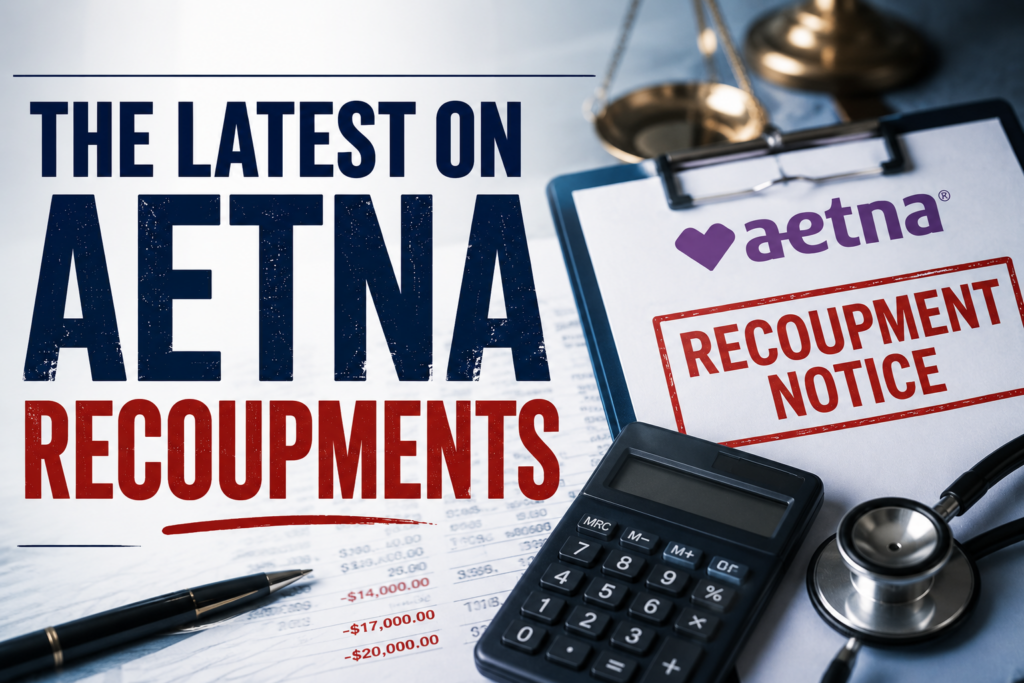
I have seen recoupments as high as $14,000, $17,000, and even $20,000.
Some providers have disputed the recoupments, but so far, those disputes have not been successful because Aetna is taking the position that it is following applicable recoupment laws.
2. Aetna said repayment plans are available — but providers are not being given a clear path to request one.
The ASA Insurance Committee wrote to Aetna when the ERA notices began coming out. Aetna responded by stating:
“We can offer repayment plans if the provider contacts the customer service number outlined in our overpayment letter.”
However, there does not appear to be a special number for negotiating a payment plan.
The letter simply states:
“If you have any questions, please contact our provider customer service center at 888-632-3862.”
That is Aetna’s general provider inquiry number. When providers call, the representatives often know nothing about these specific recoupment efforts, repayment plans, or who providers should speak with.
That is not a meaningful process.
3. Aetna is threatening to hold future payments or send accounts to outside recovery.
The letter also states:
“If your account does not have sufficient funds to cover the overpayment, we may consider placing your account on hold for future payments until there are sufficient funds to cover the overpayment, or we may forward your account to an outside recovery agency.”
This is where the situation becomes extremely serious.
Offices are now reporting that Aetna is holding all Aetna reimbursements, rather than paying current claims. For small acupuncture practices, this can be financially devastating.
In the past, offsets were generally tied to future payments involving the same employer group or same benefit plan. What providers are now reporting appears to be much broader and more damaging.
For many small practices, this is not just an accounting issue. This is a business survival issue.
What Providers Should Do Now
Any office affected by these Aetna recoupments should take immediate action.
1. File a dispute or appeal immediately.
Even if you believe the appeal may ultimately be denied, filing a dispute may preserve your rights and may give you more time.
In your dispute, include:
- The dates benefits were verified
- The reference numbers for the verification calls
- The names or ID numbers of representatives, if available
- A statement that Aetna confirmed the plan paid at 100% after the copay
- Copies of EOBs showing how Aetna originally processed the claims
- The amount Aetna is now demanding
- The financial impact this will have on your practice
You may also want to reference your state’s insurance misrepresentation laws if benefit information was incorrectly provided and relied upon.
2. Contact your U.S. Senators and elected representatives.
Explain that Aetna’s error is now being shifted onto small healthcare practices that relied on the benefit information Aetna provided.
Make it clear that providers were given only 30 days to repay, while Aetna is going back as far as 18 months to recover its own mistake.
Explain how this affects your livelihood, your patients, and your ability to continue providing care.
For New Jersey providers, Senator Cory Booker and Senator Andy Kim both have contact forms on their official Senate websites. Senator Kim is listed as a member of the Senate Committee on Health, Education, Labor & Pensions.
Being that he is on the small business committee, Senator Booker’s office may also be particularly relevant because of the small-business impact this is having on acupuncture practices. Most acupuncturists are not large medical groups. They are small businesses, often solo or very small private practices.
3. Be specific in your complaint.
Do not simply say, “Aetna is recouping money.”
Spell it out.
Explain:
- Aetna incorrectly quoted benefits.
- Providers relied on those benefit quotes.
- Aetna processed and paid the claims.
- Some providers called Aetna and were told the payments were correct.
- Aetna is now demanding repayment for its own processing error.
- Providers are being given only 30 days to repay.
- Aetna is threatening to withhold future payments or send balances to outside recovery.
- The repayment amounts may be large enough to put small practices out of business.
If Aetna is already holding your current reimbursements, state that clearly.
If Aetna has not yet held your reimbursements, you can still state that other providers have reported this and that Aetna’s letter specifically threatens this action.
4. If your appeal is denied, file another appeal immediately.
If you receive a denial, do not stop there.
Immediately file another appeal and state that you have filed a complaint with your U.S. Senator. Request that Aetna suspend or hold off on further recoupment or collection activity until your complaint has been reviewed.
Final Thought
Again, the issue is not whether Aetna has recoupment rights.
The issue is that Aetna appears to have made the error, confirmed the benefits, processed the claims, paid the claims, and in some cases confirmed the payments were correct — and now small healthcare practices are being asked to repay thousands of dollars in 30 days.
That is not reasonable.
Providers should not be expected to absorb the full financial impact of Aetna’s own benefit verification and claims processing failures without a clear, fair, and workable repayment process.