
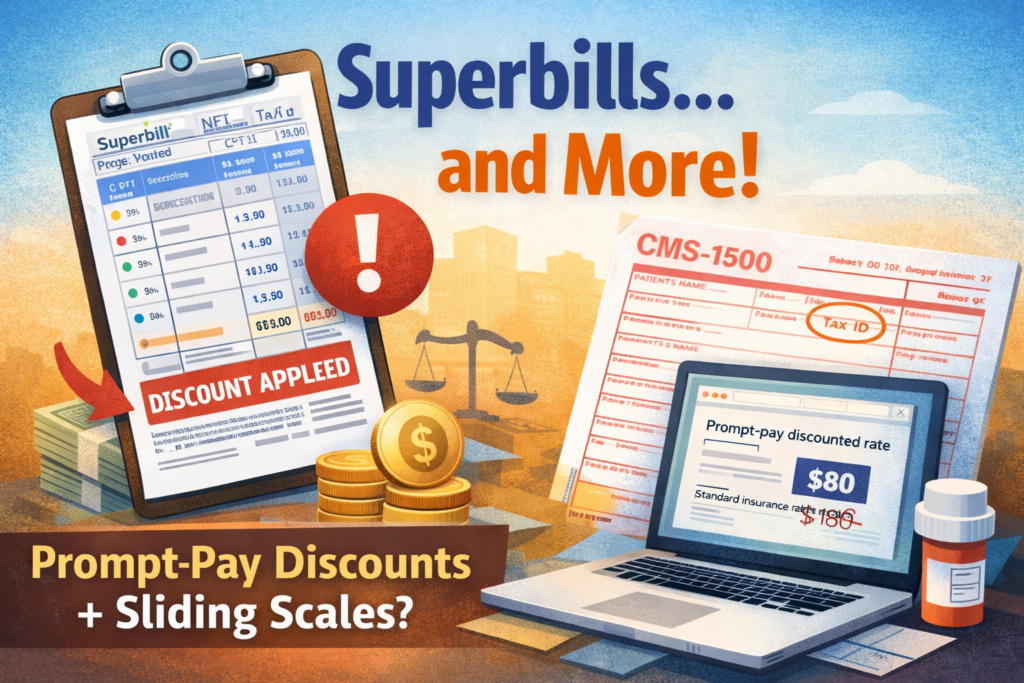
This builds on my other article about prompt-pay discounts and sliding scales—because this is where a lot of providers unintentionally get themselves into trouble.
First, let’s clear up some common questions:
Why does a provider’s Tax ID need to be on a superbill?
I get this one all the time. Just like your NPI identifies who performed the service, your Tax ID tells the carrier what entity provided it. It’s how they confirm you’re a legitimate billing entity.
Think of a superbill for what it really is—it functions very similarly to a CMS-1500 claim form. If the carrier is going to reimburse the patient, they need essentially the same information they would require if you submitted the claim yourself.
Next question: Why can’t I just put a total on the superbill and apply a prompt-pay discount?
Short answer—you can’t do that.
Ask yourself: would you submit a CMS-1500 with a discounted total at the bottom? No. Claims are line-item specific, and your documentation needs to reflect that same structure.
The correct way to handle this:
Apply your prompt-pay discount for each line item, not the total.
That means:
• Each CPT code has its own fee
• Each line reflects the discounted (prompt-pay) amount
If you’re using an EHR, this usually means configuring:
• Your standard rate (what you bill insurance)
• Your prompt-pay rate (your discounted cash price)
Another concern I hear:
“But what if the carrier sees I charge insurance more than I charge patients?”
You’re not charging patients less—you’re giving a prompt-pay discount. There’s a difference.
If your fee structure is consistent and your prompt-pay discount reasonably reflects administrative savings (commonly around ~20%), you can explain it if needed. In reality, you’ll probably never be asked.
Where this does become a problem…
Let’s say you issue a superbill showing:
• $80 for 2 units (minimum 23 minutes)
The patient submits that for reimbursement (maybe they have a high deductible and prefer your prompt-pay rate).
Then later:
• Another patient with the same insurance comes in
• You bill the carrier $180 for the exact same services
Now you’ve created a discrepancy.
This is not theoretical—I’ve worked with providers in this exact situation. The result?
• Repayments back to the insurance carrier
• Reduced allowable amounts on future claims
Same issue applies to your website pricing
If you list prices publicly, you need to be very clear:
• These are prompt-pay (time-of-service) rates
• They are discounted from your standard fees
And those discounts should be reasonably consistent (again, typically around that ~20% range tied to real cost savings).
Bottom line:
• Superbills should mirror claim-level accuracy
• Discounts must be applied per service—not as a lump sum
• Your fee structure must be consistent across the board
Because once your numbers don’t line up—that’s when the problems start.