
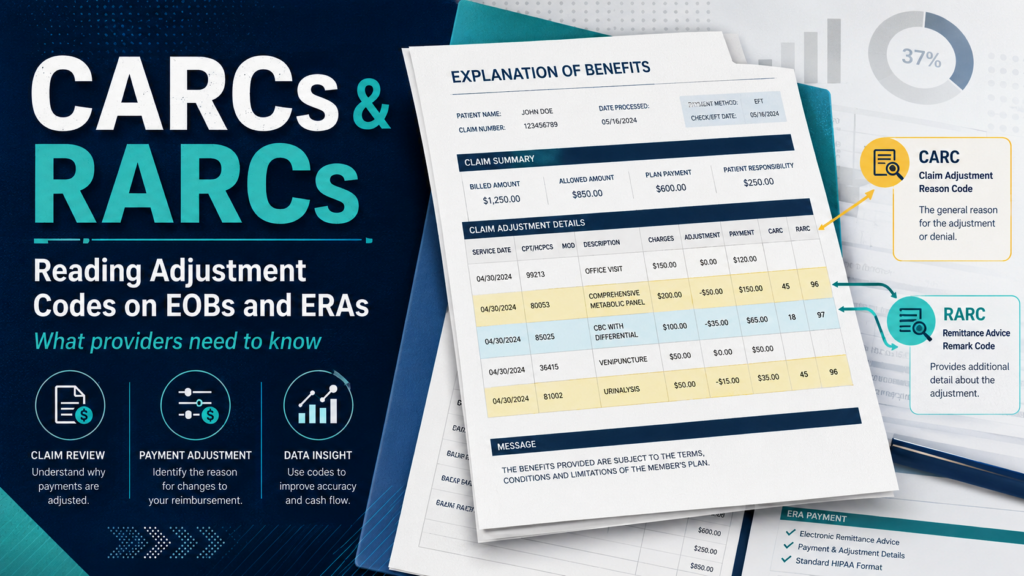
When an insurance claim is reduced, denied, bundled, or assigned to the patient, the explanation is usually found in the adjustment codes on the Explanation of Benefits, or EOB, and the Electronic Remittance Advice, or ERA.
Two of the most important types of codes are CARCs and RARCs. Understanding the difference can help an acupuncture office identify why a claim was not paid correctly and determine what action should be taken next.
What Is a CARC?
CARC stands for Claim Adjustment Reason Code.
A CARC explains the general reason the payer adjusted the claim or service. It may indicate that the charge exceeded the payer’s allowed amount, the service was considered bundled, information was missing, coverage was not available, or the service was assigned to the patient’s deductible or coinsurance.
For example:
CO-45: Charge exceeds the fee schedule or maximum allowable amount.
This usually means the payer reduced the billed charge to its contracted or allowed amount.
The number is commonly shown with a group code such as:
- CO — Contractual Obligation
- PR — Patient Responsibility
- OA — Other Adjustment
- PI — Payer-Initiated Reduction
The group code is important because it helps identify whether the adjustment is the provider’s responsibility, the patient’s responsibility, or another type of payer adjustment.
What Is a RARC?
RARC stands for Remittance Advice Remark Code.
A RARC provides additional information about the claim. It may clarify the CARC, identify missing information, describe a documentation requirement, or direct the provider to a payer policy.
For example, an ERA might show:
CO-16: Claim or service lacks information needed for adjudication.
That explanation is very broad. A related RARC might state that the rendering provider identification, referral number, medical records, or another specific item is missing.
The CARC tells you the general problem. The RARC tells you more about what caused the problem or what may be needed to correct it.
Do All EOBs and ERAs Include Both?
No. Not every EOB or ERA must include both a CARC and a RARC.
If a claim is adjusted, a CARC will generally be used to explain the financial adjustment. However, a RARC is only included when the payer needs to provide additional information.
For example, CO-45 may be clear enough by itself. The payer may not need to add a remark code.
Other CARCs are too general to be useful without additional detail. Codes involving missing information, noncovered services, medical necessity, authorization, or documentation often require a related RARC so the provider can understand the actual reason for the denial.
Some RARCs are also informational and may appear even when they are not connected to a specific financial adjustment.
Why This Matters
Offices should never rely only on the short description printed on the EOB. The adjustment codes should be reviewed carefully before rebilling, appealing, correcting the claim, or billing the patient.
For example, a denial may appear to mean that acupuncture is not covered when the actual issue is a missing modifier, an authorization problem, incomplete provider information, or a payer-specific documentation requirement.
Before taking action, review:
- The group code
- The CARC
- Any related RARC
- The payer’s provider manual or medical policy
- The original claim submission
- The patient’s benefits and authorization
Also remember that an EOB or ERA does not always provide enough information to determine whether a denial is correct. A vague adjustment code should not automatically be accepted. Contact the payer and request the specific policy, claim edit, documentation standard, or benefit provision used to process the claim.
Understanding CARCs and RARCs helps acupuncture offices respond more effectively, avoid unnecessary corrected claims, reduce improper patient billing, and create stronger appeals when a claim has been processed incorrectly.
Mori West Billing Members – I have created and uploaded Reference Guides of current CARCs and RARCs with their full descriptions in the Resources section of my website. Use this information if the EOB or ERA is vague or missing enough information for clarification. CLICK HERE to view them.