
-Kevin Barrett (MedClaim Alliance)
Not every overpayment demand is what it claims to be. Some are legitimate. If there’s a clear duplicate payment or an obvious billing error, the right move is to fix it.
But many so-called overpayments are created after the fact, not discovered. They are manufactured through reinterpretations, vendor algorithms, or internal policy shifts that didn’t exist when the claim was originally paid.
Think about what actually happened.
The claim was submitted, reviewed, and paid. An EOB was issued. You relied on that payment to run your practice. Then months or even years later, the payer decides to take another look and suddenly calls that same payment an overpayment. Nothing about the patient encounter changed. The documentation didn’t change. Only the payer’s opinion changed.
That distinction matters.
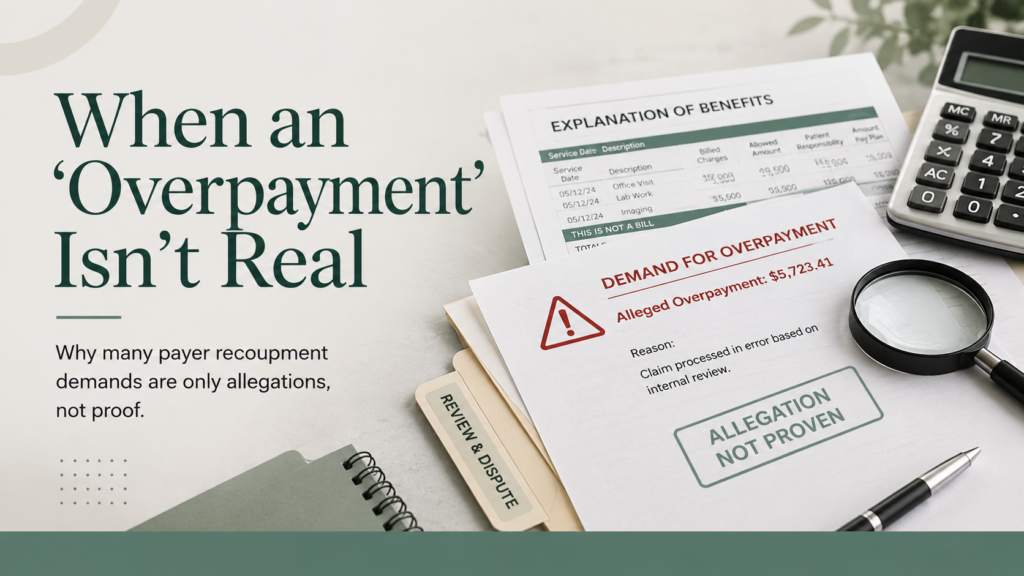
A new calculation or a different interpretation is not proof of an overpayment. It is just a new position. If the payer cannot show that the original payment violated the actual plan terms in effect at the time, then there is no established overpayment. There is only an allegation.
The problem gets worse when providers push back and receive a generic response that says the overpayment stands. These letters often look official, but they rarely address the actual issues raised. They don’t provide claim-level calculations. They don’t cite specific plan language. They don’t explain recovery authority. They simply repeat the conclusion.
That is not a real answer.
It is a non-answer.
An automated response does not end the dispute. It does not prove anything. If anything, it confirms that the payer has not done the work required to support its position. The burden is on the payer to show its math, its authority, and its basis for recovery. Until that happens, the overpayment remains unproven.
This is why every alleged overpayment should be challenged by default. If offsets have already started, those should be disputed as well. A payer should not be allowed to take money back based on assumptions, vague reasoning, or internal recalculations that were never part of the original agreement.
At the end of the day, the principle is simple.
If they claim you owe money, they need to prove it. If they cannot, you have every right to push back and demand that the funds be returned.